
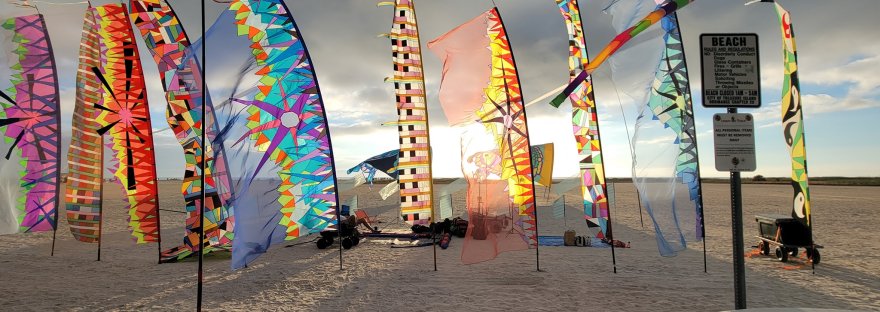
Stained glass shattering into millions of pieces… The explosive kaleidoscope captured in every kite, banner, and bol Kevin Bayless makes is an unmistakable marker in design, color, and craftmanship. Here’s what to know about Bayless, his foray into kiting, and how to come away with one of his breathtaking creations.
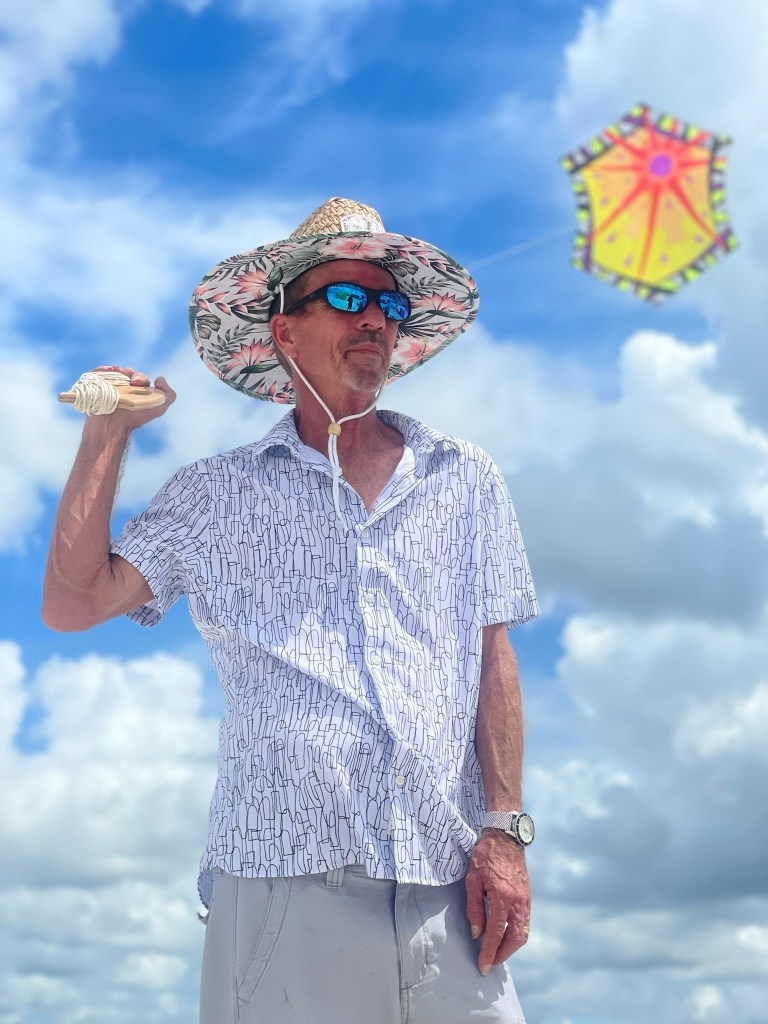
The son of an Air Force officer, Kevin Bayless moved around a lot growing up. He and wife, LynneRae, currently reside in Central Florida, retired. Bayless spent the majority of his career in construction materials sales for new home and custom home construction in addition to engaging in commercial hospitality work for Disney, Universal Studios, several casinos in Las Vegas, and some resort work. His career took him to Southern California, Colorado Springs and Salt Lake City before his pancreas ruptured, forcing him into early retirement. As you’ll learn, LynneRae is primarily responsible for Bayless making kites.
How did you get into kiting?
I discovered professional quality kites while at the beach one day in southern California. A friend had a progressive stack of dual line stunt kites, like 6 ft. and 8 ft. wide, made by Crystal Kite Company. They were ripping around, back and forth, up and down and loud. My friend let me try them and, after some basic instruction and flying them, I was hooked.

The following week I went to a kite shop in Seal Beach that had an 8-foot Crystal dual line for sale… $200.00 for the kite and a set of Skyclaw handles and 150ft. of Spectra line. Now the hard part… explaining it to LynneRae! Her response was legit, but I stand by justifying the purchase based on the “how cool it was” factor.
I flew that kite every day after work, ruined more than a few pairs of jeans with grass stains and, in a couple months, the trailing edge of the kite was fraying. I contacted Crystal Kites, and they told me to bring it by their shop and they’d take a look at it, so I did just that. Turned out to be a guy and his wife making kites in their garage, and they agreed to replace my kite with their newest version, which I still have. At this point, I wanted more kites and knew LynneRae wouldn’t let me purchase any, but was pretty sure I could make them.
This was all before the internet was up, so printed publications were the best sources for info and that’s where I found Hang ’em High for parts and fabric. Then I picked up an old sewing machine from the pawn store. For $85 I then purchased enough material for about five kites. I taught myself to sew, and those first kites were horrible. BUT… We knew a blind kite flyer, Ralph Counsel. Those who know him know. He flew the third kite made, right after he flew it, he demanded we sell it to him, so I did for $85.00. So, I then saw a path forward to keep making kites and supporting my hobby to some degree.
How did you hone your skills over the years and who, if anyone, influenced you?

My early time making kites was concentrated on dual-line stunt kites. It was the early 90’s, and kiting was huge all-over Southern Cal. I developed a three-kite progressive stack starting with a 6 ft., then 8 ft., then 10-ft. dual line. They flew amazing, and I was taking orders for custom stacks. Then I saw a larger foil style kite at a San Diego monthly kite fly. At the same time, I’d accumulated a lot of scrap fabric and was trying to figure out what to do with it. I couldn’t throw it away!
With no plans or information on the actual design of a foil, I decided to make an 8ft. x 8ft. parafoil using scrap to make the face and keels. It didn’t work too well, but I had a good start. I found a private pilot handbook that had the design for a Clark Y foil, maybe the most common profile for small single engine planes. I used that to modify the profile on my kite, and it worked. With so much scrap, I figured I could make a big foil. I designed a kite and came up with plans enabling me to figure any measurement of any part of the kite based on a percentage of the chord length.

Eventually, I made a 192 square ft. parafoil from scrap fabric and took it to Berkley, my first big festival in 1993. Without knowing it, we set up camp right next to George Ham. He was a wonderful gentleman and very giving of information. I learned a lot from him that weekend. That weekend I also met Bob Anderson, which started a long friendship with many adventures, including a couple trips to Verdun and Berkley, even flying a kite in a Levis shorts commercial. My next foil was 300 square ft., 15′ x 20′, the face and keels all from scrap.
Well over 30 years ago, Ron Gibian told me the secret to being known as a kite builder is to develop a personal style, something that when in the air, people will recognize it as yours. I think I’ve accomplished that.
What do you look for when designing a new creation?

Scrap fabric for me, when I see a bin full or a bag full of cutoffs and pieces, I see an incomplete kite. The fact that I am not an artist – I don’t do sketches or mockups or drawings of any kind – is why I like using scrap. I try to use contrasting colors, warm tones, cool tones and I fill the shape of the kite I want with those colors. Generally, I’ll try working from darker colors to lighter colors and enjoy doing off-center designs. I try to keep it simple.
Rokkaku kites are such a great, easy platform for graphics that are straight lines, due to the contortion of the frame and sail during flight. It’s an easy kite to make and even easier to fly. I make 4ft. and 8ft. Roks, Most get sold these days, so trying to keep a quiver of kites to fly keeps me making them, which I love. I also like making Bols and Banners.
How can people buy a Kevin Bayless original?
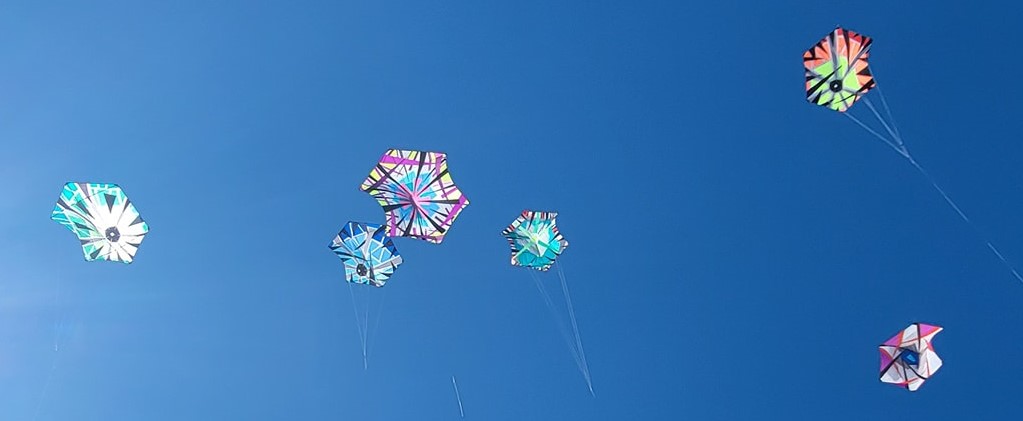
I don’t have a website or official outlet for my stuff, I do have a group page called, Stoopid Bags By Kevin, or people can just message me on Facebook.
Kiting has always been just a hobby, a way for me to release creativity that bounces through my head continually. I’m blessed that other people find value in what I do, and I will continue to do so as long as possible.

 Michael K. Sherman